In high-end architectural glazing, retail point-of-sale (POS) displays, protective machinery guards, and illuminated signage, optical edge transparency is a core mark of component quality. When raw master plastic sheets are cut down into custom parts using CNC routers, panel saws, or laser cutters, the freshly exposed edges inevitably exhibit micro-grooves, cutter chatter marks, and a dull, frosted haze.
To eliminate these visual defects and achieve a seamless glass-like finish, industrial fabricators rely on specialized edge finishing techniques. For complex non-standard geometries, custom acrylic sheet polishing via controlled flame treatment—known as flame polishing—remains one of the most versatile and cost-efficient methods available. This guide explores the thermodynamic principles behind flame polishing, how it performs on fabricated PC sheets vs. PMMA acrylic, and how to optimize edge quality for B2B OEM manufacturing.
The Thermal Science Behind Flame Polishing Plastic Edges
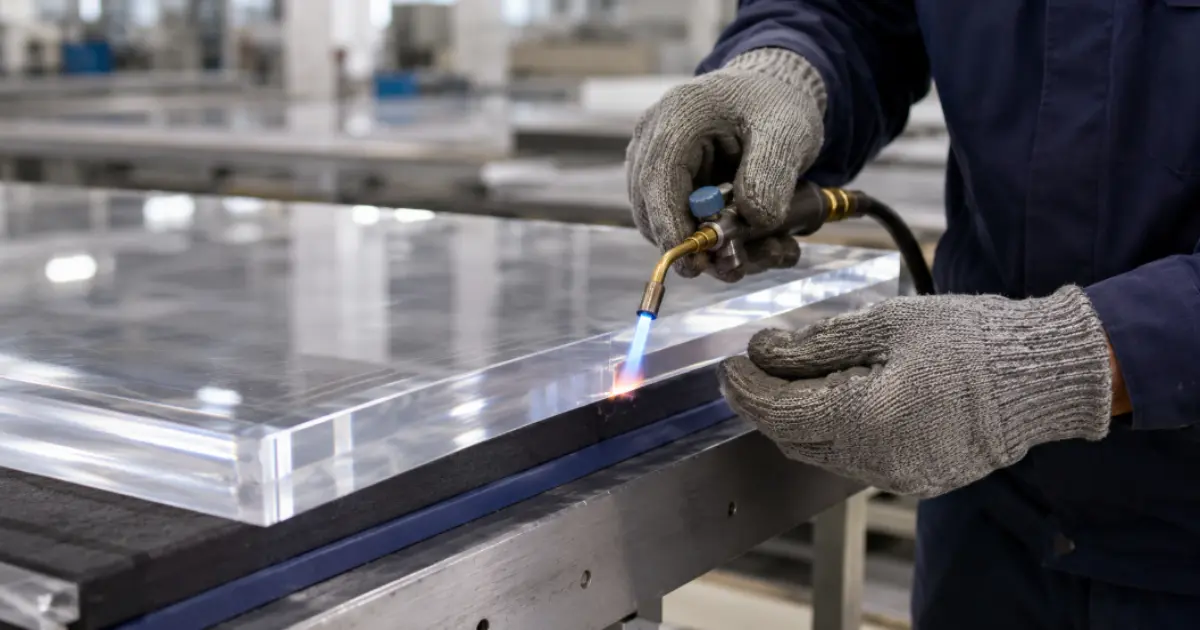
Flame polishing is a thermal surface-refining process. A high-temperature flame (typically produced by a micro hydrogen-oxygen generator or a regulated propane burner) is swept rapidly along the machined plastic edge.
The intense localized thermal energy briefly brings the surface layer of the thermoplastic above its glass transition temperature ($T_g$) and melt flow point:
- Acrylic (PMMA): Reaches liquid surface flow easily at approx. 180°C – 220°C. Surface tension causes the molten polymer micro-peaks to melt and level out into a perfectly smooth plane before rapidly re-solidifying.
- Polycarbonate (PC): Has a higher heat deflection temperature ($T_g \approx 145^\circ\text{C}$) and melt point (approx. 260°C – 290°C). PC requires faster torch passes and precise air-fuel ratios to prevent localized yellowing or combustion soot.
Step-by-Step OEM Fabrication Workflow for Optical Clarity
Achieving crystal-clear edge transparency requires strict pre-treatment and post-treatment control. Simply holding a torch flame to a rough saw-cut edge will cause bubbling and thermal stress.
- Precision Machining: Master sheets are routed using single-flute solid carbide bits with high chip-load toolpaths to minimize heat buildup and deep tooling marks.
- Sequential Mechanical Sanding: Cut edges are deburred and dry/wet-sanded with progressive grit sequences (typically 240-grit $\rightarrow$ 400-grit $\rightarrow$ 800-grit) to remove macro cutter gouges.
- Flame Pass Execution: A trained operator passes the torch tip at a consistent distance (approx. 15 mm – 25 mm) and steady speed across the edge. Multi-pass technique allows gradual thermal leveling without burning.
- Stress Relief (Annealing): Because rapid thermal cycling induces surface tension, high-specification technical parts undergo oven annealing to eliminate micro-stress and prevent post-fabrication solvent crazing (cracking).
Technical Comparison Table: Edge Polishing Method Evaluation
When specifying custom fabricated plastic components, choosing the right polishing technique depends on part geometry, sheet material, and production volume:
| Technical Parameter | Custom Flame Polishing | Diamond Edge Polishing | Mechanical Buffing & Wheel Polishing |
|---|---|---|---|
| Compatible Materials | PMMA Acrylic (Excellent), PC (Good with skill) | PMMA Acrylic (Excellent), PC (Fair/Gummy) | PMMA, PC, ABS, PETG (Universal) |
| Geometric Flexibility | Highest: Curves, internal cutouts, bevels, flame fits tight contours easily | Limited: Straight linear sheet edges only | Moderate: External contours and flat edges |
| Edge Clarity Level | High Optical Clarity (Glass-like 90%+ transmission) | Ultra-High Mirror Finish (95%+ transmission) | High Polish (Requires compounding pastes) |
| Production Speed & Labor | Fast execution, minimal mechanical setup | Extremely fast for straight rectangular sheets | Labor-intensive, manual multi-stage process |
| Residual Thermal Stress | Moderate (Requires annealing for chemical resistance) | Very Low (Cold mechanical cut) | Low-Moderate (Frictional heat) |
| Cost Efficiency for Non-Standard OEM | Best value for complex custom shapes & short-to-medium runs | Best for mass straight-panel sheet distribution | Best for prototype touch-ups and repair |
Key Differences When Polishing Acrylic vs. Fabricated PC Sheets
While both materials are optically clear transparent engineering thermoplastics, their molecular structures demand distinct processing parameters:
- Acrylic (PMMA): Naturally flame-friendly. The monomer chain melts cleanly without significant degradation, making custom acrylic sheet polishing the industry standard for display cases, light guides, and luxury fixtures.
- Fabricated PC Sheets: Polycarbonate is tougher and highly flame-retardant. When exposed to direct flame, PC oxidizes more rapidly. Achieving glass-like clarity on fabricated PC sheets requires clean hydrogen-oxygen flames (water-welder systems) to eliminate carbon residues and precise torch speed to avoid surface bubbling.
Frequently Asked Questions (FAQ)
What is custom flame polishing for fabricated acrylic and PC sheets?
Flame polishing is a thermal edge-finishing process that uses a high-temperature, controlled hydrogen-oxygen or propane flame to briefly melt micro-scratches on cut plastic edges, flowing the resin flat into a glass-like optical shine.
Can polycarbonate (PC) sheets be flame polished the exact same way as acrylic (PMMA)?
While acrylic flame-polishes effortlessly into crystal clarity, polycarbonate requires precise thermal control and surface preparation (sanding/deburring) to prevent edge soot or surface blushing, making skilled torch operator control essential.
Does flame polishing cause internal stress or micro-cracking (crazing) on plastic sheets?
Rapid surface heating introduces localized thermal stress. To prevent crazing—especially if parts contact solvents or adhesives later—Viethung Plastics performs thermal annealing on critical components after flame polishing.
How does flame polishing compare to diamond edge polishing or mechanical buffing?
Flame polishing is significantly faster and more cost-effective for intricate curved profiles, internal cutouts, and bevels where rigid diamond tooling or buffer wheels cannot easily fit.