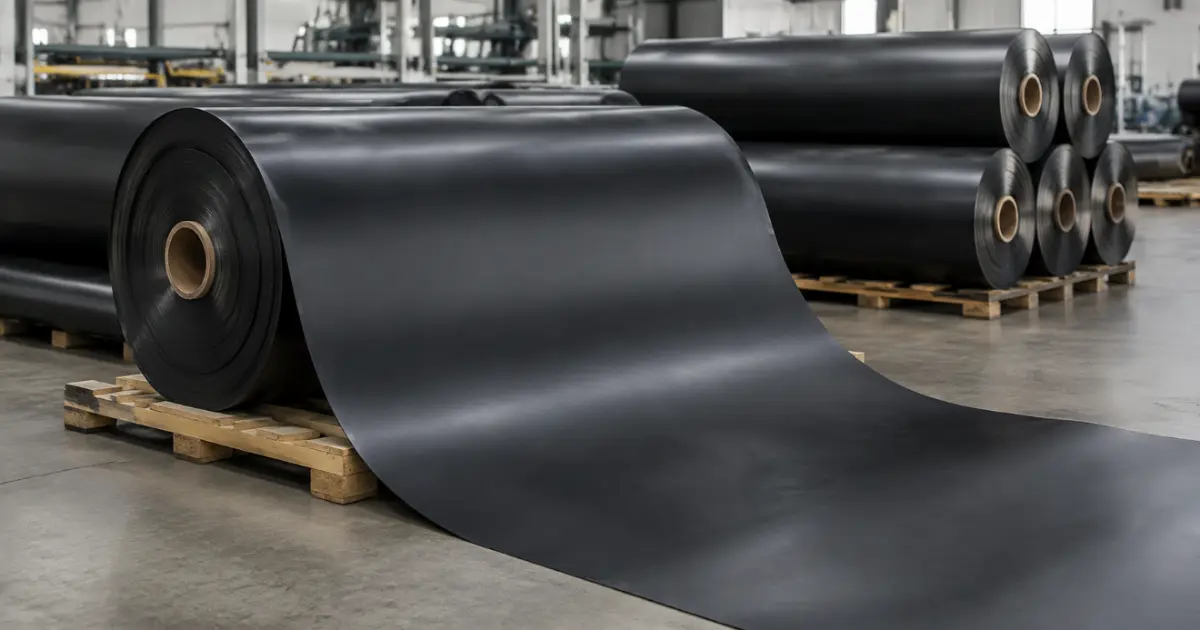
Selecting the ideal containment material for agricultural reservoirs, commercial aquaculture ponds, and industrial wastewater storage is a decision that dictates long-term structural integrity and maintenance costs. Discover why engineering teams and farm managers are transitioning from conventional rigid PVC boards to flexible, high-density polyethylene sheets—specifically designed HDPE sheet for water storage and heavy-duty HDPE pond liner sheet solutions.
The Critical Engineering Demands of Water Containment Systems
Water storage structures, whether earthen farm ponds, concrete lined reservoirs, or aquaculture tanks, operate under continuous environmental stress. Containment liners must withstand severe hydrostatic pressure, ground movement, thermal expansion, and intense solar radiation without developing micro-cracks or pinhole leaks. While standard PVC rigid sheets have historically been utilized for small static tanks, their inherent stiffness makes them susceptible to brittle fracture under dynamic load or low temperatures.
In contrast, flexible HDPE sheets combine high tensile elasticity with chemical inertness, enabling them to conform seamlessly to ground contours while providing total hydraulic isolation.
5 Key Reasons Flexible HDPE Sheets Superiorly Outperform PVC Rigid Sheets
1. Superior Flexibility, Elongation, and Stress-Crack Resistance
Standard PVC rigid sheets possess a low elongation break percentage, meaning any ground settling or mechanical impact easily causes snapping or seam rupture. Flexible HDPE sheets boast elongation at break values exceeding 700%. This extraordinary flexibility allows high-density polyethylene to absorb subgrade shifts, seismic vibrations, and heavy liquid pressure without structural tearing.
2. Unmatched Weatherability and Long-Term UV Stability
Rigid PVC contains plasticizers and fillers that gradually leach out when exposed to sunlight and standing water, leading to discoloration, chalking, and severe embrittlement within 2 to 3 years. OEM-extruded HDPE pond liner sheet products from Viethung Plastics are formulated with high-grade carbon black (2.0–2.5%) and thermal stabilizers, delivering exceptional UV resistance and operational lifespans exceeding 20 years in direct sunlight.
3. Non-Toxic, Eco-Friendly Profile for Aquaculture and Potable Water
Unplasticized or rigid PVC formulations often retain heavy metal stabilizers (such as lead or organotins) and phthalates that can leach into liquid over time, posing risks to aquatic life and crop irrigation. HDPE is a non-toxic, chemically inert thermoplastic that meets strict food-grade and environmental safety standards, ensuring zero harmful chemical migration into aquaculture ponds or drinking water reserves.
4. Superior Thermal Operational Range and Cold Cracking Prevention
Rigid PVC becomes dangerously brittle at freezing temperatures, cracking upon mild stress at 0°C or below. Flexible HDPE retains its high impact resistance and ductility down to extreme temperatures of -60°C, making it reliable for high-altitude reservoirs, cold climate farms, and harsh outdoor installations.
5. Seamless Hot-Melt Field Welding and Leakproof Reliability
Rigid PVC sheets rely on solvent cement or brittle adhesive bonds that degrade under aquatic pressure. HDPE sheets are joined using double-wedge thermal extrusion fusion welding, creating continuous, permanent, homogeneous seams that are stronger than the parent sheet itself, ensuring 100% leakproof security across large surface areas.
Technical Performance Comparison: HDPE Sheets vs. PVC Rigid Sheets
The comparative data below demonstrates why high-density polyethylene is the preferred specification for industrial and agricultural water storage:
| Technical Property | Flexible HDPE Sheet (Viethung OEM) | Standard PVC Rigid Sheet | Performance Impact on Containment |
|---|---|---|---|
| Density (g/cm³) | 0.94 – 0.96 g/cm³ | 1.38 – 1.45 g/cm³ | HDPE is lighter, reducing freight costs and field installation labor. |
| Elongation at Break (%) | ≥ 700% | 10% – 25% | HDPE easily conforms to uneven subgrades without cracking. |
| Low Temperature Limit (°C) | -60°C to -70°C | 0°C to -5°C | Prevents brittle cold-weather cracking during winter months. |
| UV & Weather Resistance | Excellent (Carbon Black Stabilized) | Fair to Poor (Prone to plasticizer leaching) | HDPE provides 20+ years outdoor service life vs 2-5 years for PVC. |
| Toxity & Toxicity Leaching | Non-toxic, safe for fish & potable water | May leach heavy metals & phthalates | Protects aquatic biological health in shrimp/fish aquaculture. |
| Seam Joining Method | Hot-wedge thermal fusion welding | Solvent bonding or adhesives | Welded HDPE joints form a continuous monolithic liquid barrier. |
Custom B2B Sourcing and OEM Manufacturing at Viethung Plastics
As a non-standard custom plastic sheet manufacturer based in Vietnam, Viethung Plastics produces tailored flexible HDPE sheets designed for demanding liquid containment applications. We provide complete customization options for commercial projects and OEM distributors:
- Custom Sheet Gauges and Widths: Extruded thicknesses from 0.5mm to 10.0mm, with custom roll widths or flat sheet sizing to fit your specific reservoir dimensions.
- Textured vs. Smooth Surfaces: Available in smooth finish for maximum liquid flow or single/double-sided textured finishes for anti-slip slope stability on embankment walls.
- UV & Oxidation Package Customization: Tailored additive formulations optimized for tropical high-UV environments or chemical resistance against agricultural fertilizers and slurry.
Looking for reliable HDPE sheet suppliers for your next aquaculture pond or water storage project? Contact Viethung Plastics engineering team today to request technical data sheets, custom quotes, or material samples.
Frequently Asked Questions (FAQ)
Q1: Is HDPE sheet safe for aquaculture, fish ponds, and drinking water storage?
Yes. Flexible HDPE sheets are 100% non-toxic, eco-friendly, and chemically inert. Unlike PVC, HDPE contains no plasticizers or heavy metals, making it completely safe for shrimp, fish, aquatic ecosystems, and potable water storage.
Q2: Why is flexible HDPE better than PVC rigid sheet for lining earthen ponds?
Earthen ponds undergo subgrade settling and thermal expansion. Rigid PVC cannot deform without cracking, leading to leaks. Flexible HDPE exhibits over 700% elongation at break, allowing it to conform smoothly to ground irregularities without tearing.
Q3: What thickness of HDPE sheet should be used for water containment?
Typically, 0.75mm to 1.0mm HDPE sheets are used for standard agricultural ponds, 1.5mm to 2.0mm sheets are specified for heavy-duty commercial aquaculture and wastewater lagoons, and thicker sheets (over 3.0mm) are used for structural tanks or primary containment pads.