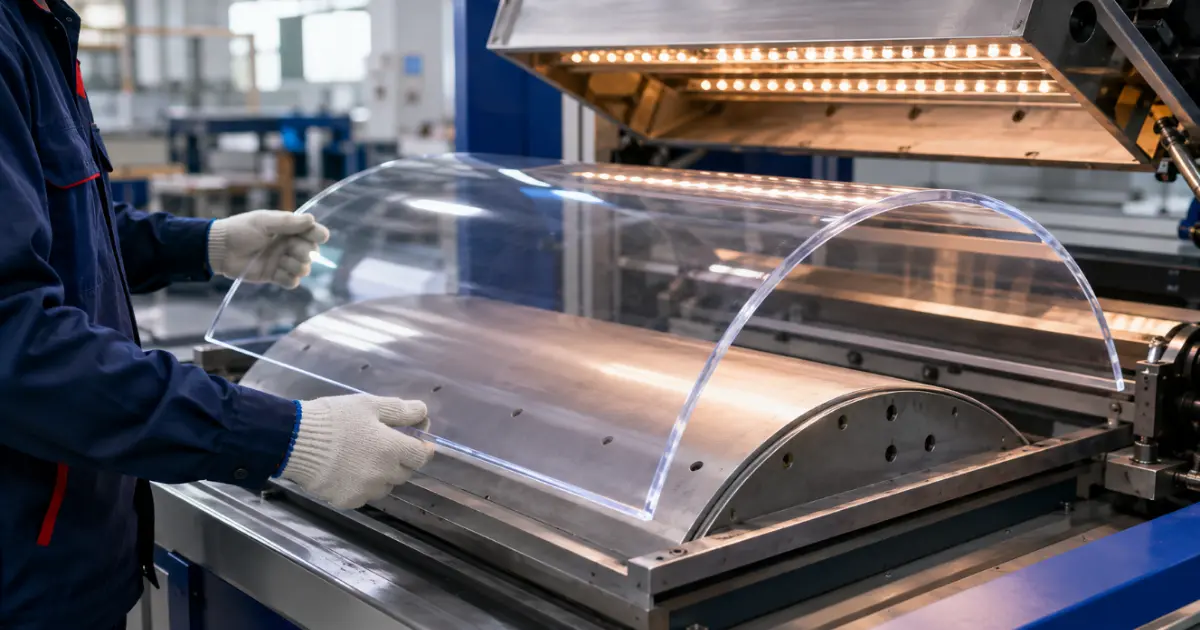
Polycarbonate sheets have become a core structural glazing choice in modern architecture, valued for their virtually unbreakable impact resistance, optical clarity, and lightweight nature. When designing curved facades, barrel-vault skylights, or custom architectural partition walls, fabricators face a crucial choice: cold bending vs. heat bending. Specifying the correct fabrication technique for custom polycarbonate panels avoids internal material stress, optical distortion, and costly site failures.
Understanding the Basics: Cold Bending vs. Thermal Bending
Polycarbonate (PC) exhibits high ductility and impact strength compared to standard acrylic (PMMA) or annealed glass. This elastic behavior allows it to be curved on-site or in the shop without thermal processing, provided parameters stay within strict mechanical thresholds.
However, when architectural designs require tight radiuses, sharp multi-angle bends, or 3D forms, thermal line bending or oven drape forming must be employed to permanently reshape the polymer chains.
Cold Bending Polycarbonate Sheets: On-Site Flexibility
Cold forming involves mechanically flexing the sheet directly into curved aluminum mullions or curved support frameworks at ambient temperatures. It eliminates heating energy, reduces factory labor, and provides clean continuous curves over long spans like covered walkways and arched skylights.
1. Calculating the Minimum Cold Bending Radius
The single most important technical metric when bending polycarbonate sheet material without heat is the minimum cold bending radius (Rmin). Exceeding this limit subjects the outer surface to excessive tensile stress, causing micro-crazing, premature clouding, or stress cracking under sunlight exposure.
Formula: Rmin = 175 × Sheet Thickness (t)
For example, a 4mm solid sheet requires a minimum radius of 700mm, whereas an 8mm sheet requires at least 1400mm radius.
2. Managing Elastic Springback and Fastener Stress
Cold curved panels remain under continuous internal tension. Structural framing and clamping profiles must be engineered to withstand ongoing springback force. Fastener clearance holes must be drilled slightly oversized to accommodate thermal expansion combined with cold-stress movement.
Heat Bending Polycarbonate Sheets: Precision Custom Geometries
When the design calls for sharp structural angles, 90-degree corners, or radiuses tighter than 175 times the thickness, heat bending (line bending or drape forming) is required.
1. Strip Heating (Line Bending)
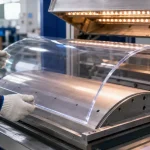
Using single or double-sided electric resistance heating elements along a target axis, the localized strip is heated to the glass transition temperature (around 155°C to 160°C). Once soft, the sheet is bent to the desired angle over a jig and held in position until cooled below 80°C.
2. Pre-Drying Requirements
Polycarbonate is hygroscopic and absorbs atmospheric moisture. Heating moist polycarbonate directly above 150°C turns entrapped moisture into expanding steam pockets, producing tiny permanent surface bubbles within the bend zone. High-grade custom architectural panels must be pre-dried in air-circulating ovens at 120°C prior to intensive thermal molding.
Technical Comparison: Cold Bending vs. Heat Bending
Selecting the optimal method for your custom polycarbonate panels depends on radius requirements, production budget, and installation conditions:
| Parameter / Metric | Cold Bending (Cold Forming) | Heat Bending (Line / Thermal) |
|---|---|---|
| Minimum Bending Radius | R ≥ 175 × Thickness (Gentle curves) | R < 175 × Thickness (Tight curves / 90° angles) |
| Residual Internal Stress | Moderate to high (Continuous elastic force) | Near zero (Stress relaxed through heat cycle) |
| Equipment Required | Mechanical framing / clamping profiles | Strip heater, bending jig, pre-drying oven |
| Pre-Drying Needed? | No | Yes (Essential to prevent internal micro-bubbling) |
| UV Layer Integrity | Maintained if R ≥ Rmin | Requires uniform heating to avoid thermal UV degradation |
| Primary Applications | Barrel vaults, acoustic barriers, curved glazing | Corner covers, architectural finials, machine guards |
Essential Fabrication Tips for Custom Architectural Panels
To guarantee long service life and crystal-clear aesthetics in architectural applications, keep these practical fabrication procedures in mind:
- Orient the UV Surface Outward: Most architectural grade solid PC sheets feature a co-extruded UV barrier on one or both sides. Ensure the primary UV protected face is positioned towards external solar radiation.
- CNC Edge Polishing & Chamfering: Saw marks and micro-fractures along cut edges act as stress concentration points during cold flexing or line heating. Route and chamfer all edges smooth prior to bending.
- Thermal Expansion Gap: Polycarbonate has a thermal expansion coefficient of approximately 0.065 mm/m°C. Structural framing channels must leave sufficient clearance for temperature fluctuation.
Custom Polycarbonate Fabrication at Viethung Plastics
At Viethung Plastics, we produce UV-stabilized, high-impact solid polycarbonate sheets engineered for challenging architectural projects. From custom precision cut-to-size panels to thermoformed architectural components, our OEM extrusion lines in Vietnam deliver tight tolerance specifications for global contractors and cladding specialists.
Planning a curved facade or requiring technical samples for your project mockup? Contact Viethung Plastics technical team today for direct OEM quote and fabrication guidance.
Frequently Asked Questions (FAQ)
Q1: Can multiwall polycarbonate sheets be cold bended like solid sheets?
Yes, multiwall polycarbonate hollow sheets can be cold curved longitudinally (parallel to the flutes/ribs). However, the minimum bending radius is wider (typically 150 to 175 times the sheet thickness depending on structure). Bending across the flutes is not permitted as it will collapse the internal ribs.
Q2: Why did bubbles appear along the heated line during thermal bending?
Bubbling during line heating is caused by absorbed ambient moisture evaporating inside the resin. Pre-drying the polycarbonate sheet at 120°C prior to heating removes absorbed moisture and yields crystal-clear thermal bends.
Q3: What non-standard customization options does Viethung Plastics provide?
We supply custom sheet lengths, non-standard thickness variations (1.5mm up to 15mm), dual-sided UV capping, anti-scratch coatings, light-diffusing tint formulations, and precision CNC edge processing tailored to your architectural drawings.