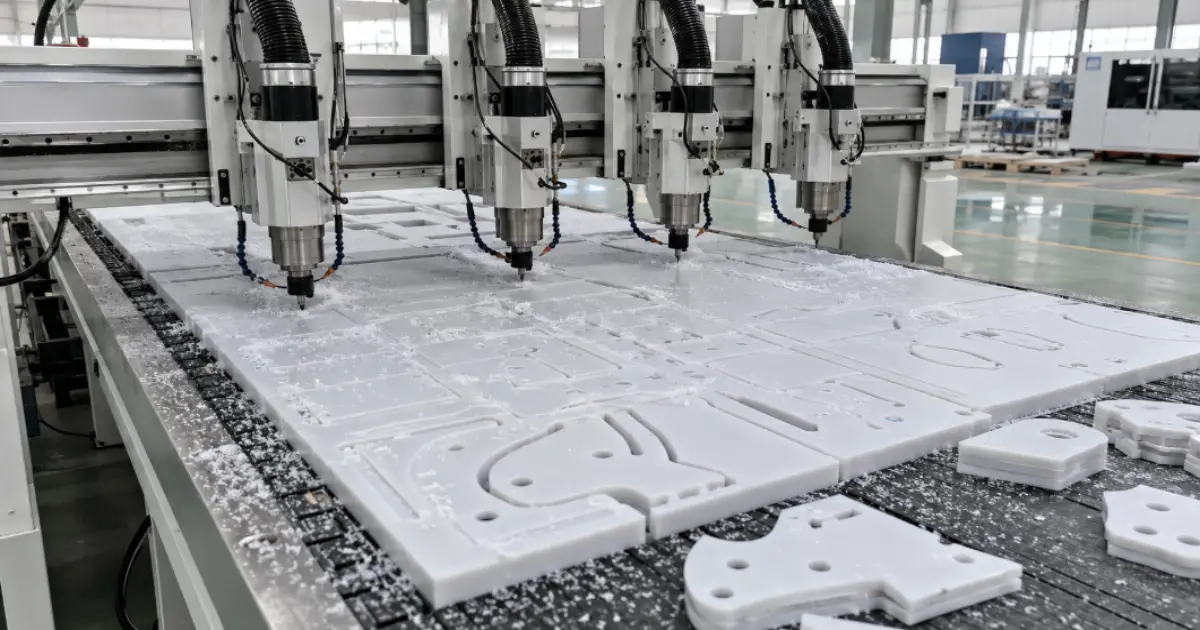
In high-volume B2B manufacturing and custom equipment fabrication, selecting the right material processing method directly dictates overall component cost, project timelines, and raw material efficiency. When converting master engineering plastic sheets—such as HDPE, PP, POM, or ABS—into custom parts, procurement teams face a critical choice: CNC plastic sheet cutting with automated nesting versus traditional conventional saw cutting.
While manual or sliding table saw cutting appears cost-effective for simple straight cuts, it often introduces hidden expenses in the form of high kerf loss, labor-intensive secondary deburring, and low sheet yield. This technical comparison analyzes how modern multi-axis CNC nesting technology optimizes material utilization and reduces unit costs for custom cut plastic sheets in Vietnam.
Understanding Material Yield: Kerf Loss and Layout Efficiency
When cutting raw plastic stock, material yield is determined by two main factors: tool kerf width and layout geometry optimization.
- Conventional Saw Cutting: Table saws and beam saws use circular blades with a typical kerf width of 3.2 mm to 4.5 mm. Furthermore, saw blades can only make full-length straight linear cuts. Non-rectangular shapes or complex internal cutouts require secondary handling, producing high amounts of unusable off-cut scrap.
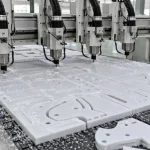
- CNC Nesting Method: Computerized nesting algorithms automatically arrange non-standard parts, curved profiles, and varied geometries across the entire master sheet area. CNC end mills (typically 3.0 mm to 6.0 mm) follow optimized single-pass toolpaths, achieving yield rates exceeding 85% to 92%.
Thermal Management and Edge Quality Differences
Engineering plastics possess relatively low thermal conductivity and low melting points compared to metals. High-speed saw cutting generates intense localized friction, causing localized edge melting, micro-cracking, and heavy burr formation. Eliminating these defects requires manual edge scraping or flame polishing, adding labor overhead.
In contrast, CNC plastic sheet cutting utilizes specialized single-flute or O-flute solid carbide bits combined with continuous air-chill systems. This prevents thermal stress buildup, yielding clean, burr-free chamfers and precise dimensional accuracy within ±0.15 mm.
Technical & Economic Comparison Table
| Evaluation Parameter | Conventional Saw Cutting Method | Precision CNC Nesting Method |
|---|---|---|
| Dimensional Tolerance | ±1.0 mm to ±2.0 mm | ±0.1 mm to ±0.3 mm |
| Material Yield Rate | 65% – 75% (High off-cut waste) | 85% – 95% (Optimized nesting layout) |
| Geometric Capability | Straight line rectangular cuts only | Arbitrary shapes, holes, slots, chamfers |
| Edge Surface Finish | Rough, melted burrs, saw blade marks | Smooth, burr-free, stress-relieved edge |
| Secondary Processing Needed | High (manual deburring/drilling) | None or Minimal (one-step process) |
| Best Suited For | Low-volume rough panel sizing | High-precision, non-standard OEM components |
Cost Analysis: Evaluating Total Part Cost
Although CNC router programming incurs a minor initial setup fee, the overall unit cost for custom non-standard components is significantly lower due to three main factors:
- Raw Material Savings: Reducing scrap by 15% to 20% offsets processing fees, especially on high-value engineering resins like POM, UHMW-PE, or PC.
- Elimination of Secondary Operations: Drilling, countersinking, and profiling occur in a single CNC setup, replacing multiple manual bench steps.
- Repeatability & Low Rejection Rates: Automated CNC production eliminates human measurement error, ensuring consistent fit for assembly lines.
Frequently Asked Questions (FAQ)
How much material waste can CNC nesting save compared to conventional saw cutting?
CNC nesting algorithms optimize irregular shapes across full master sheet dimensions, typically increasing material yield by 15% to 25% compared to linear manual saw cuts.
Why is CNC nesting better for thick engineering plastic sheets like HDPE or PP?
Thick plastic sheets generate high friction heat during saw cutting, leading to edge melting, burrs, and residual stress. CNC routers use dedicated end mills and cooling toolpaths to maintain clean, stress-free edges.
Can Viethung Plastics process custom non-standard drawing formats for CNC cutting?
Yes, our engineering team accepts DXF, DWG, STEP, and IGES CAD files to program direct CNC nesting toolpaths for custom fabricated plastic components.